

Key Takeaways
- The Paradigm Shift: Profitability in 2026 is driven by how you operate, not where you play. The contraction of standard markets has pushed a massive wave of complex, unstructured risk onto underprepared desks in the $115.6B E&S powerhouse.
- The Cost of Inertia: Traditional automation has hit a hard ceiling. Relying on slow, legacy workflows has driven U.S. P&C administrative costs per policy up by 34%, leaving slow-moving firms heavily exposed to severe adverse selection.
- The Strategic Alpha: Next-generation agentic workflows are driving a 300 to 500 basis point improvement in loss ratios by eliminating the 40% underwriting efficiency gap.
For decades, the strategic direction of the Property & Casualty (P&C) industry was dictated by a single, deceptively simple question: Where should we play?
Success meant finding the right niche, identifying an underserved pocket of risk, or riding a hardening market cycle in a specific line of business. But even after picking a territory, macro headwinds and operational inefficiencies could easily be absorbed by healthy premiums.
In 2026, that kind of strategic direction is obsolete.
The reason? An unprecedented level of volatility.
The global risk landscape now includes climate anomalies, rapid regulatory shifts, economic fluctuations, and social inflation. Today, profitability depends significantly less on what specialty niche you occupy and far more on how you operate within it.
The Rise of the $100B+ E&S Powerhouse
The most visible symptom of this market shift is the explosive, sustained growth of the Excess & Surplus (E&S) and Specialty markets (AM Best). Driven by standard carriers contracting their appetites to avoid volatile, non-standard risks, the E&S sector has experienced years of consecutive, double-digit premium growth and now has firmly cemented its status as a $100B+ powerhouse.
This structural shift brings a unique operational challenge: The Overflow of Complexity.
By definition, E&S risks are non-standard. They do not fit neatly into the structured dropdown menus of a legacy core system. An underwriter evaluating a specialty risk is routinely flooded with unstructured data:
- Hundreds of pages of unformatted historical loss runs
- Detailed engineering and inspection reports
- Bespoke legal addendums and complex manuscript forms
When billions of dollars in premiums flow out of standard admitted systems, they land on desks that are fundamentally unequipped to process them efficiently.
Firms relying on fragmented digital tools or slow, manual workflows quickly find themselves facing severe adverse selection. In the specialty space, it takes days to triage an intake packet. As a result, the structural cost of doing business climbs; in the United States, administrative costs per policy in the P&C industry have surged by 34 percent.
While P&C carriers have struggled to limit these rising operational expenses, they have been completely outpaced by other sectors like the automotive and telecommunications industries, which have aggressively adopted modern tech infrastructure to protect their margins.
Now that forward-thinking P&C operators are adapting to agentic workflows, they can instantly identify and bind coverage on the highest-quality submissions. This inevitably shifts the market balance, leaving only the slow, complex, lower-yield risks behind for the competitors who refuse to adapt.
Behind the Curtain: The 40% Underwriting Efficiency Gap
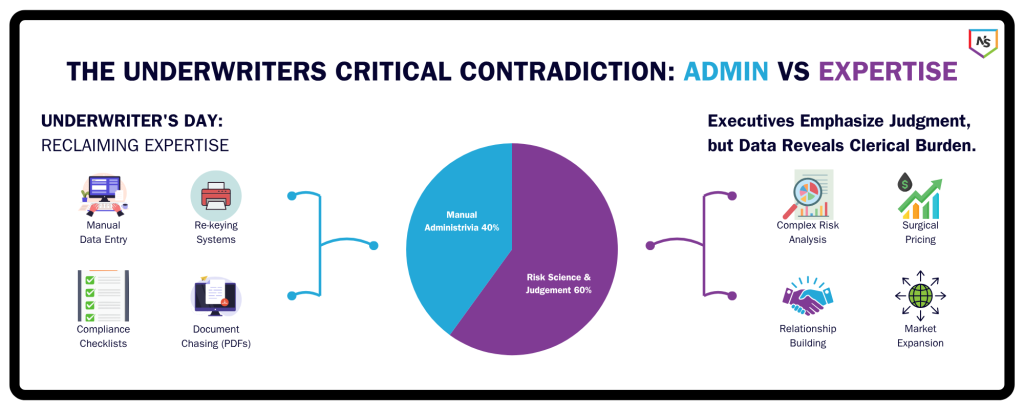
The specialty insurance sector faces a critical contradiction. Executives frequently emphasize the irreplaceable value of human judgment, yet operational data reveals that an organization’s most expensive assets, seasoned underwriters, are rarely utilized for their expertise.
Industry analysis consistently demonstrates that underwriters spend roughly 40% of their day on administrative, low-value tasks. This “administrivia” includes manual data entry, re-keying submission details across multiple internal systems, cross-checking basic compliance checklists, and chasing missing documents.
Consider the typical workflow of a multi-line commercial submission:
- An assistant or underwriter opens an email containing a dozen unstructured PDF attachments.
- They manually extract values to map them into an internal rating engine.
- They copy historical loss numbers into a separate spreadsheet to calculate a crude burn cost.
This is not risk science; it is clerical labor disguised as underwriting.
This 40% efficiency gap represents a significant financial loss for insurance organizations. When technical experts spend nearly half their time acting as data entry clerks, several operational failures occur simultaneously:
- Submission Bottlenecks: Highly profitable, winnable submissions sit in a stagnant, first-in-first-out (FIFO) queue while underwriters manually clear out junk files.
- Underwriter Burnout: Talented risk professionals become fatigued by repetitive software navigation, degrading the quality of their cognitive analysis on complex exposures.
- Compressed Turnaround Times: The organization’s speed-to-market drops significantly, alienating key wholesale brokers who demand rapid responses.
To close this gap, the industry must fundamentally redefine the relationship between software and human professionals. The goal should not be to replace the underwriter with an algorithmic “black box,” but rather to allow experts to spend 100% of their operational day performing high-value risk analysis and strategic negotiation.
The Bottom-Line Reality: A 300–500 Basis Point Lever
For insurance operators, operational efficiency is never purely about convenience; it is directly tied to the financial bottom line.
Research from McKinsey & Company indicates that carriers and MGAs that successfully digitize and optimize their full end-to-end value chain see an immediate 300 to 500 basis point (3% to 5%) improvement in their loss ratios.
In a capital-intensive industry where a combined ratio fluctuation of half a point can separate a stellar year from an operational deficit, a 3–5 point lever on the loss ratio is transformative.
This improvement is not just technical cuts or a reduction in claims payouts. Insurance companies achieve this by systematically elevating the accuracy of an organization’s day-to-day decisions:
Enhancing Underwriting Excellence
Instead of straight-through processing based on whichever file happens to be next in the inbox, an optimized operation uses predictive scoring to instantly highlight risks with the highest statistical probability of binding profitably.
Pricing Elasticity Insights
When an operation captures and structures 100% of its incoming submission data, including the risks it declines, it creates a proprietary market asset. Advanced analytics also allow underwriters to improve loss accuracy,
For instance, data might reveal that adjusting a specific rate by a minor margin increases the bind rate on high-quality risks from 2% to 22%, allowing for surgical adjustments rather than blunt, across-the-board rate changes.
Elimination of Leakage
A digitized value chain ensures that compliance guardrails, exclusion clauses, and risk thresholds are consistently maintained across the entire portfolio. This eliminates the operational “leakage” that occurs when an overworked underwriter misses a critical exclusion keyword tucked deep inside a non-standard manuscript policy.
Conclusion
The 2026 insurance market has moved beyond finding the right niches to working on the inefficiencies of existing ones. With complexities and more and more competitors integrating artificial intelligence, insurance companies have no choice but to adapt to new technology.
In today’s era, firms that continue to rely on manual data entry, rigid software tools, and fragmented workflows will inevitably face margin compression, slow turnaround times, and adverse risk selection. Many brilliant minds spend most of their day working on tasks that could easily be automated.
As a result, companies that fail to innovate remain stuck in a race to the bottom. They try to cut corners and view technology merely as a means to trim a few cents off an operational expense line.
The reality is very different for market leaders. Market leaders in the insurance industry know that operational inefficiencies are culprits behind insurance company closures. They understand that in a highly volatile landscape, the ability to simply “process” data is no longer a competitive advantage; it is merely table stakes.
The true differentiator is the ability to translate data complexity into high-precision execution. Technology, in essence, is a key to automating manual administrative tasks, liberating their best minds, and unlocking true strategic growth.